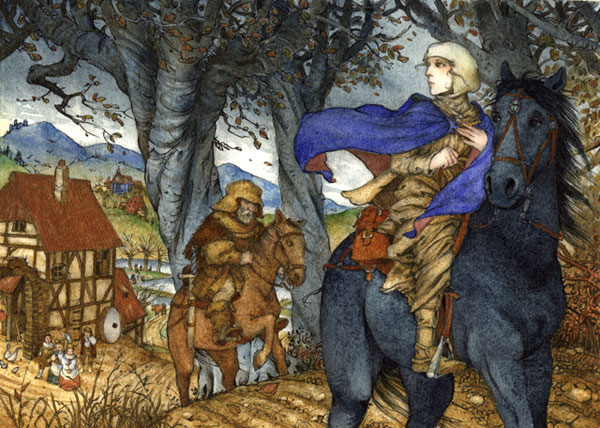
I can't remember a time when I wasn't avidly interested in fairy tales, folk tales, and myth. I had the usual suspects in early childhood--fat anthologies with sturdy canvas covers, the dust jackets long gone, that collected a little bit of Grimm, some Hans Christian Anderson, maybe a couple of French or Italian variations. I had skinny illustrated single-shot stories, where the pictures overshadowed the familiar but infinitely varied Beauty and the Beast or Thumbelina.
My favorites were a gorgeous Beauty and the Beast illustrated by Mercer Mayer, who did the popular Little Monster books for young readers. But his B and the B is darker, weirder, wildly romantic, scary, and irresistible.
It's twisted and windy, and the promise of a happy ending seems pretty dubious.
I also loved a little known Grimm tale called The Water of Life, illustrated by Trina Schart Hyman. The story of prince on quest gets a welcome detour when we dwell on the endeavors of the princess to rescue him when his treacherous brothers betray him. I love the pictures of the heroine getting things done.
Swords! T-squares! Schematics! Just a couple of lions NBD!
The biggest event in my story consumption was when I was eight and my father started dating the woman who became my step-mother. She gave my brother and me a massive tome of Italian Folk Tales compiled by post-modern rockstar Italo Calvino. It was 200 stories, full of the usual royalty and peasants on quests, but also including a few curve balls: incest, murdered bodies transforming into rosemary bushes, necrophilia, an evil wizard's soul kept safe in a blood-red egg.
I love stuff like that. I love it when the combined pleasure of familiarity and surprise come together in the matter-of-fact recounting of the fantastic. The characters, which should be flat by virtue of time limit and the prominence of plot, are instead able to assert their courage, their hubris, and their needs in just a few pages.
One of the stories that's always haunted me and that ended up having a role in The Other Island is the myth of Cupid and Psyche. There's a very similar plot in the Scandinavian story East of the Sun and West of the Moon. It has an arc called "The Lost Husband."
Psyche is a lovely girl who inspires the envy of Venus. Venus sends her son, Cupid, to shoot one of his arrows into her heart and make her fall in love with some monster in order to punish her. Instead, Cupid sees her beauty and shoots himself. He invites Psyche to marry him, but hides his identity and says she must never look at him. Someone, envious sisters or the jealous Venus, makes her doubt her husband and say he must be a monster. In the middle of the night, she lights a candle to look at him. Struck by his great beauty, she lets drops of wax fall on him and he wakes up in alarm, says he has to leave and she won't find him until she completes a number of impossible tasks. She gets to work and wins him back.
Or at least that's how I remember it. There are many elements that I love about this story. In the Scandinavian version the young woman is wooed by a great white bear, which I find enormously appealing. Illustrated versions of the tale show the woman being carried away into a snowy night on the back of the enormous beast. Sometimes it's the tasks that catch my fancy. I like the version in which she just has to walk. She doesn't have a destination, but she must keep going until she wears out seven pairs of iron shoes, seven iron mantles, and fills seven bottles with her tears.
But the main plot points that bring me back to the story again and again to read for my own pleasure, or to use in my writing, are two powerful and opposing forces: Doubt and determination. She doubts her love, or her lover. She has to see. As a skeptic, of course I understand this action, even though it condemns her over and over. Even if it's not doubt, it could be curiosity. It could be the very natural impulse to want to know all about the one you love, warts and all. How can you love if you don't know? How can you be loved without being seen? The other driving force of the story is her redemption, when she sees everything she has and loses it all in the same act. She knows exactly what she wants and will do anything to get it. I think of the satisfaction she has along with the pain as she walks along the road or weeps into the neck of a wine bottle or makes her shirts of nettle.
One thing that doesn't get asked enough is why exactly her love interest has to hide from her in the first place. I suppose he has his reasons, but the story isn't about him.
The Other Island draws on a lot of other stories. I took favorite fairy tales and myths and poked at images and ideas that were important to me and stuck under my skin for decades, and combined the concept of story-telling into the plot itself. It feels like full circle for what stories mean to me and my relationship to them.
There are plenty of other writers that combine stories so old they're in the bloodstream and out of copyright. There's something deeply satisfying about taking the bare bones of a fairy tale--two or three pages of irrational magic, characters that are archetypal cut-outs, and usually an act or two of age-inappropriate violence--and seeing it fleshed out into a novel.
One of my favorite writers is Mary Renault for her skill with this kind of adaptation. Renault was a serious scholar, and has an uncanny ability to abolish a modern-day context and make you half-consider worshipping the old gods. My favorite of her books is The King Must Die.
This is a retelling of Theseus and the Minotaur. Thinking of the version in my beloved Dulaire's Greek Mythology, my biggest impression from that story is the winding through the Labyrinth and the frail little trail of thread. The fight with the beast barely seemed like the point, but the idea of being entombed underground stuck with me. In Renault's version, the story is completely absorbing, but more than that, the characters are as rich and relatable as their counterparts from a modern setting. What they do is completely rational given that gods watch and walk among them. Renault never falls into the fatal historical fiction trap of swaddling a character in modern political or social sensibilities. Her people and plots have their own context and rules, and they abide by that, not what would make the reader feel comfortable or righteous. It makes for unsettling and disorienting reading sometimes. Who would I be and what would I think if I were in a Renault novel, and what choice do I really have in who I am now?
All that plus bull-dancing!
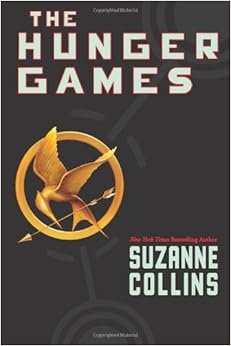
Another author who has had wild success with well-trod plot and themes is Suzanne Collins of the Hunger Games hegemony.
I don't know why I'm bothering to add an image here, it's burned into your brain whether you read the books or not. I enjoyed the books very much, I think on the basis of the compelling premise and the voice of the heroine, the super-human but also extremely human and hubristic Katniss. Collins borrowed heavily for her plot, but made the wise move of shifting the setting to the future instead of the past, and her character's voice is all her own.
But her influences are evident. A lot of critics point to the similarities to the 2000 Japanese cult classic Battle Royale.
Which, yes, it's a pretty clear precursor. If you haven't seen it, please do.
But to come full circle yet again, Collins also borrowed from a much more obscure source: Mary Renault's The King Must Die. This is the source of the concept of a conquering society demanding a tribute, and also the show-stealing scene of the hard to like Katniss volunteering to take the place of her younger sister.
Theseus makes a similar sacrifice, based not on the desperate need to save someone beloved, but in a move that is both politically expedient for his royal father and in keeping with his honor as a man. He becomes a shrewd leader, bringing together a team that survives against the odds, and, like Katniss, using his position to overthrow a tyrant.
Collins took some great but under-the-radar source material and turned it into an empire.
***
I like hearing the same story over and over, with variations on a theme. When I was a kid, the repetition was key, now I'm more interested in the variations and transmutations. There's something specifically satisfying about taking a familiar story and bending it in a different direction, with another emphasis and a richer world. It's like reconnecting with a childhood friend and realizing they're much weirder, smarter, funnier, and sicker than you knew they were when you were both in kindergarten.
Walking and writing are inextricable from each other for me. When I'm writing, I need to walk to develop important plot points or understand character drive and motivation. I'm a slack-jawed snack-obsessed gold-bricker at my desk, unable to generate fresh ideas or think of what comes next. I have to move. And when I'm walking, my brain wants to turn to whatever I'm writing.
I've lived in the same neighborhood for six of the seven years I've been working on this book. My routine is monotonous: Walk north through the towering trees and grand, slightly surreal houses to Prospect Park.
I take the path past the playground and up the rickety stone staircase, down the dip where families picnic and play soccer on summer weekends, past the gingko trees that spatter the asphalt with foul-smelling fruit in the fall, into the little grove of pine and oak where the acorns can lie like ball-bearings on the path, waiting to get underfoot and send me scurrying the last few feet to the top of the park, then down again. Sometimes I just wander around the grid of hundred year old houses.
Every inch is familiar, which plays a key part in my writing process.
Once I'm back at my too-small desk, I can sit down and take the walk again in my head. I can think of the question that I set out with from my doorstep, and unspool the inspirations that hit me along the way. I can remember a particular turn of phrase that seemed so good as I was at the garden with all the lilac, and the plot twist that ties parts two and three together at the corner with the bodega.
Brooklyn is a long way from the island I imagined, but I can visit my book with every step I take.
One night I was at a bar with my friend Anna and some of her music school buddies. When I say music school, I mean some horrifyingly advanced doctoral students of everything from ethnomusicology to composition. They were a neat bunch, even if most of them were talking so far over my head that I could hear only a faint zooming noise.
There was one lady who studied music in the movies, so I snagged her and made her talk to me about John Carpenter soundtracks. When I mentioned I was writing a horror novel, she got a baffled, concerned look on her face. "I don't know how a book can be really scary. I mean, it doesn't have any sound."
I hadn't considered this. When I think of the match-up between books and movies, I usually think in terms of visuals. Gore, grossness, jump scares. I don't have access to any of them. But I also don't have building strings or sinister french horns to raise the tension, or Foley art giving a nice juicy squelch to a decapitation or the chalky screech of fingernails clawing desperately at the edge of a pit.
What I do have is music to make an atmosphere and set a mood while I write. And when I say write, I'm counting the process of walking around and coming up with plot ideas or snippets of dialogue or description. I almost never have awesome ideas sitting at a computer and chewing my knuckle and clicking over to old-timey book illustrations or octopus videos. I have them walking around, listening to music to set the mood, then I play the list back to recapture the feeling when I'm trapped at my desk.
I started making mix tapes in high school, back when they were tapes. I made them mostly for my mother, a captive audience (she also read all eleven drafts of this book, she is ready to be canonized), but soon I was making them just for me. My first serious writing tape after college, when I sat in the basement of my childhood home, was 90 minutes long and constituted not only a carefully calibrated blend of tunes but served as a timing device. I had to write the entire 90 minutes every day. I mostly remember that it had Pachelbel's canon and Closer back to back.
For the last two years of writing The Other Island, I shifted the narrative from an exclusive one person point of view to three different characters. I made Spotify playlists for all of them so I could get into character as I thought about what they would do and how they would be feeling in any point of the plot.
Iris has a lot of the angsty 90s songs that were popular when I was her age. There's Gin Blossoms, Better Than Ezra, Filter, Pearl Jam and PJ Harvey. There's also a lot of spooky folk. Neko Case, Goldfrapp and Joni Mitchell give the mix a nice feminine voice.
This song by the La's sums up Iris's state in the book the best. Surrounded by the people who love her and all alone, which is maybe how she wants to be.
Cybil is Iris's mother. She's driven by fear and anger for most of the book, and she's exactly the right vintage for a lot of loud electronic therapy-fodder tunes. Ruiner by Nine Inch Nails is something she would listen to while running.
Peter has a lot of layers, and a lot of history, but by the end of the book his heart's on his sleeve.
The reader may not be hearing the music, but I'm hoping the mood and emotions comes through.
I started writing this novel seven years ago.
It was in the wake of writing in the 3 Day Novel Writing Contest. I wrote a western over a long weekend, and then felt cocky. I started out thinking I would continue to push the concept of the contest, to just write fast and hard, and play with genres and plot premises that were fun and easy.
I thought I'd take on the genre of YA fantasy. In my work as as an assistant at a literary agency, I'd seen way too many submissions of this kind of book. There were plenty of things I liked about YA: it's about a really interesting time of life, it can have great dialogue and honest portrayals about kids and their families and environments, and it can play with truly creative concepts. There were also fatal flaws that I saw repeated ad infinitum in the submissions I read: flat characters, overwrought emotion, lazy plot twists that assumed kids wouldn't notice or care.
So I thought I'd build a better mousetrap with a quick novel I wrote on evenings and weekends when I came home from the office. I chose a setting that was familiar and beloved: Providence, Rhode Island. I chose a premise that was close to my heart: Nightmares.
Within a few months, I knew I was in over my head. The quick decisions I'd made about my characters weren't working out. I'd written a villain who I ended up liking a lot. The real-life setting of the city of Providence offered some great detail, but pinned me down in actual fact too much. The plot almost but didn't quite make sense. I scrapped it and started over, feeling confident from the lessons I'd learned the first time around that I'd quickly resolve my issues.
Seven years and ten drafts later, I have the novel that's burning a hole in my hard drive. The glib mission I'd set for myself is long-forgotten. It's no longer a YA fantasy, but a literary fiction horror show. I ate a lot of hubris in this process and came out knowing so much more about writing, reading, and dreaming.
The Other Island is a story of family and friendship. It's about loyalty and betrayal. It's about conflicting desires that dig deep under the skin. It's about being more than one person in a lifetime. It's about the stories we tell about ourselves. It takes familiar fairy tales and myths and recombines them to make a new world.
I wrote this book for me, but I also wrote it for you, and I hope you like it.